{Advice} When to mail your wedding invitations?

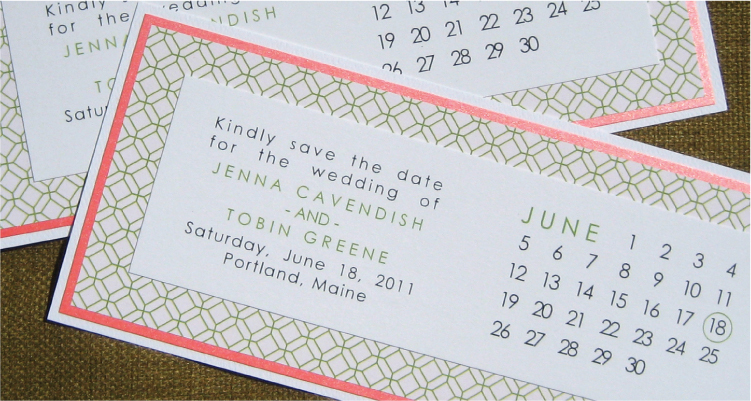
Coral and Jade Green Save-the-Date

The date you mail your wedding invitations is important.  Send them too late and your guests won’t have adequate time to book travel.  Send them too early and you risk (dare I say it?) being forgotten amidst the chaos of the rest of life.  And how does sending a save-the-date affect your invitation mailing date?  Here are some guidelines for mailing wedding invitations:

1.  If the majority of your guests are local:

Mail your wedding invitations 4 to 6 weeks prior to your wedding date.  This is the traditional mailing timeframe, and because local guests won’t need to book travel, this should leave adequate time for them to put your wedding on their social calendar.

If you sent a save-the-date and most of your guests are local: Still mail your wedding invitations 4 to 6 weeks prior.

2.  If a significant number of your guests live out-of-town:

Mail your wedding invitations 6 to 8 weeks prior to your wedding date.  This gives out-of-town guests time to book travel, but it isn’t so far in advance that your wedding will be overlooked.

If you sent a save-the-date and many of your guests live out-of-town: Still shoot for mailing your wedding invitations 6 to 8 weeks prior, but since your guests have been well-informed, if you can only manage 4 to 6 weeks prior, don’t fret.

TIP for inviting out-of-town guests:  Be a hero to out-of-town guests by including information about lodging near your wedding venue.  Let them know how far the suggested lodging is from the nearest airport, and give them some idea of the transportation situation:  will they need to rent a car?  Is there public transportation available?  Are you providing a shuttle service between the suggested lodging and your wedding venue?  Include this information on an enclosure with your wedding invitation, if possible.  Otherwise, include this information on your wedding website, or ask family members to share it with others.

3.  If you’re having a destination wedding:

Mail your wedding invitations 2 to 4 months prior to your wedding date, depending on whether your wedding will be held in this country or another country.  Mailing your invitations out early allows guests to obtain a passport, if needed, and arrange for travel.

If you sent a save-the-date and you’re having a destination wedding: Mail your wedding invitations 2 months prior if you included travel information with your save-the-date.  If you did not include travel information with your save-the-date, mail destination wedding invitations at least 3 months prior to your wedding, and include travel information with the invitation.

TIP for destination weddings:  Consider using the services of a travel agent to help your guests book their travel.  A travel agent will ensure that all your guests understand your weekend itinerary and know when to arrive and when to depart.  She’ll also help your guests get the best rates, prepare properly for travel, and serve as a singular point-of-contact during their trip.  Send your travel agent’s contact information in your save-the-date or with your wedding invitation.

So when should you order your invitations?

After you’ve determined the appropriate mailing date for your wedding invitations, the next step is making sure you order your wedding invitations far enough in advance to get your invitations in the mail.  Here’s a quick guide for turnaround time on wedding invitations, from first thought to mailbox:

Online/Mail-Order Invitations: Order pre-designed invitations from online and mail-order sources 1 to 3 months in advance.  Expect delivery of your invitations in 3 to 8 weeks, depending on the company you’re ordering from, and the type of printing process you select.  You’ll need at least week to address your envelopes if you’re doing it yourself.  If you hire a calligrapher, give her at least 3 weeks to address your envelopes.

Custom Invitations: Contact your custom stationer at least 3 months in advance to allow time for a design consultation, sample creation and revisions, and order fulfillment.  If time is an issue, ask your custom stationer to send your mailing envelopes in advance so you can have the addressing done by the time your invitations are complete.  Custom stationers will often arrange for calligraphy services on your behalf, also.

Save-the-Date: Dogwood Blossom Stationery & Invitation Studio, LLC

The save-the-date in the photo above was created in a coral and jade green palette.  It uses multiple layers, including textured white, pearlized coral, a custom modern geometric wallpaper design in jade green, and a final printed layer included a circled-date calendar.
{Advice} How much to budget for wedding invitations?

Wedding Budget Example

One of the first and most important questions I ask people who call my studio is, “What is your budget for invitations and paper goods?”  I ask this question because the work I do is custom, and as such, I can recommend invitation styles, papers, and embellishments that work within the client’s budget.  I like working with the positive:  “This is what we can do with your budget.”  I feel like there’s nothing more cruel than getting a bride hooked on an invitation adorned with loads of freshwater pearls, for instance, and then telling her, “Sorry, that’s not going to work out for you,” so I avoid that scenario if at all possible.

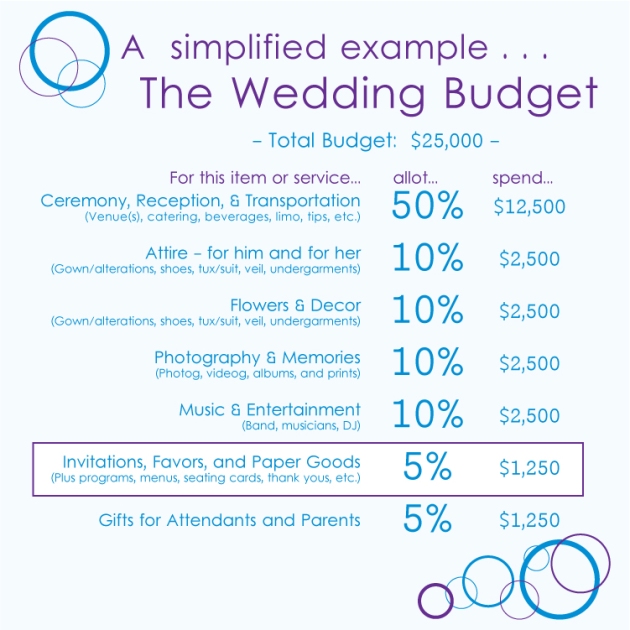
When I ask about budget, though, many people don’t know how to respond.  They tell me they don’t know what to expect, and ask me to advise them.  The quick answer is: you should spend about 5% of your overall wedding budget on invitations and paper goods.  But things are often a bit more complex than, so today’s post offers an overview of wedding budgeting, and some tips for getting the most bang for your buck.

Most bridal magazines and websites out there provide a budget planning worksheet of some sort.  Some are very specific and outline every possible item or service you could ever have at your wedding.  But in the graphic above, I’ve kept things pretty simplified and grouped things into major categories.

I used a $25,000 budget for the example above, and as you can see, if you put 5% of this budget towards wedding invitations, favors, and other paper goods, you have $1,250 to spend on wedding stationery.  This includes your invitation ensemble (invitation, envelopes, and all enclosures), thank you cards, wedding programs, menus, escort cards, table numbers and other signage (“Reserved”), and favor tags/packaging.

All of the above is simply a basic, non-personalized guideline, though.  Here are a few ways to squeeze everything you love into your wedding budget:

Budgeting Tip #1 Adjust your wedding budget to fit the thing(s) you love most into the plan.  Every bride has something they just must have at their wedding, and for all brides, it’s a different “something.”  Maybe you can’t live without the designer gown, but could care less about extravagant centerpieces.  In that case, transfer some of the money allotted to flowers to your attire.  Maybe you feel invitations play an important role in exciting your guests, and you have a very small bridal party to purchase gifts for.  In that case, allot a larger percentage of your budget to invitations, and a smaller percentage to gifts.

Budgeting Tip #2 Remember to factor in the cost of taxes and tips.  When you receive quotes from vendors, ask if tax is included in that quote, and if not, ask how much tax to expect.  Here’s a great article on wedding tipping.

Budgeting Tip #3 You will most likely spend more than you originally plan because small details have a tendency to add up.  If you really want to stay within your budget, I suggest leaving a 10% window for “unexpected details” and things you didn’t think of.  So if you’re willing to spend an absolute maximum of $25,000 on your wedding, then enter a $22,500 budget into your wedding budget worksheet.

Happy budgeting!

{Invitation Inspiration} Mixing Formal & Fun

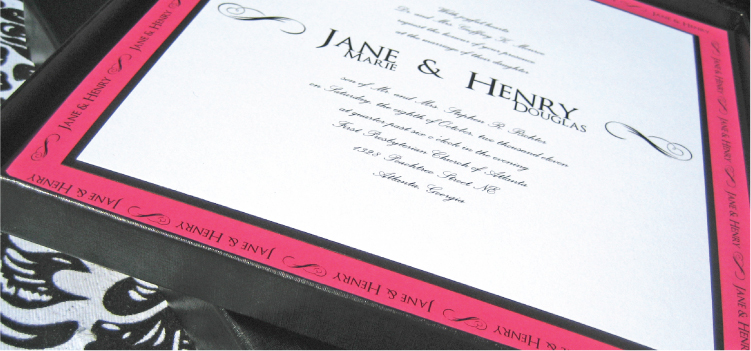
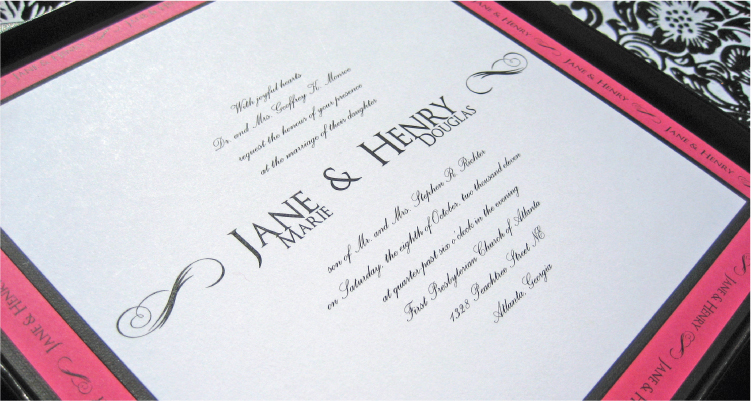
Black and fuchsia square wedding invitation in slimline mailing boxBlack and fuchsia square wedding invitation in slimline mailing boxBlack and fuchsia square wedding invitation in slimline mailing box

Several weeks ago, I met with a new client for a design consultation, and she was in a conundrum.  Her wedding is going to be very formal, but she really wants an invitation filled with color and printed with her wedding motif.  She was concerned that a colorful, highly designed invitation would not convey the formality of her wedding.

While it is true that in days past formal invitations were very straightforward – black text printed on white or ivory cards with few accents or design work – that isn’t the case today.  Formal invitations can be just about anything you want them to be.  However, there are a few guidelines that will help your guests understand that your event will be formal.

TYPESTYLE

Typestyle can be the first indication of what to expect at an event.  While there aren’t hard-and-fast rules, and anything is possible within the world of design, here are a few tips for choosing the typestyle of your invitation.

Serif fonts (think Times New Roman-style), also called block fonts, are very traditional, and work best for very formal weddings.  Consider pairing a block font with a traditional script font and you’ve got a very classic, formal typestyle.

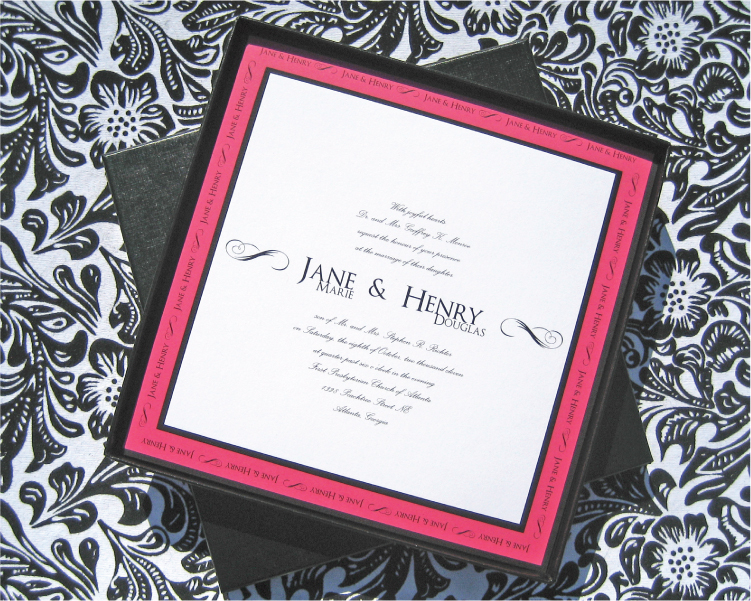
In the photos above, for instance, I used a classic all-caps block font with a traditional script font.  To make it more interesting, I switched the usual roles of the fonts: I used the block font for the bride and groom’s names, and the script font for the invitation text.  (Note:  When using script fonts for invitation text, be sure to choose a script that’s easy to read, and be sure to print it a little larger that you might print a block font.  Remember, one of the most important “etiquette” rules is ensuring that you make things easy for guests.  It’s not all about eye-candy!)

On the other hand, a script font that verges on modern “handwriting” tells guests that the event will be less formal, perhaps even casual.  This type of font is best used for less formal weddings, outdoor weddings, beach weddings, or destination weddings.  Sans serif fonts – those without the little nubbies on the ends of the letters (think Arial- or Verdana-style) – are also great for informal events, but depending on their usage, they can also be used for a formal wedding with a contemporary look and feel.

WORDING

Wording is the second major indicator of the formality of your wedding.  If you’re planning a formal wedding, it’s best to stick with traditional wording and leave out additional text like rhyming lines.  Also, be sure to spell out all words, even numbers, and do not use abbreviations.

Did you know that technically, wording varies based on whether you’re being married in a religious setting.  For instance, if you’re being married in a church, the wording: “requests the honour of your presence” is appropriate.  If you’re having a civil ceremony, the wording: “requests the pleasure of your company” is appropriate.

For less formal wedding invitations and casual invitations, wording can literally be whatever you’d like it to be, as long as the who, what, when, where, why information is being given.  Abbreviating dates is perfectly acceptable if you choose to do so, and will often help convey the fun and casual nature of your event.

ADDITIONAL LINES

If your event is black-tie, it is acceptable to print “Black tie” or “Black tie optional” in a lower corner of the invitation or below the invitation text.  Likewise, if you’re having a beach wedding and you don’t want guests wearing heels, consider printing “Casual attire” in the corner.  Doing so will give your guests official “permission” to dress down.

So… now that you have a few general guidelines, go for it – mix some fun, color, and unexpected elements into your formal wedding invitation!

And above all else, remember: the most important thing to keep in mind – not just for your invitations, but for all aspects of your event – is to make things easy and fairly obvious for guests.  Convenience and conveyance of information is the real reason behind etiquette rules, afterall.

Boxed Invitation: Dogwood Blossom Stationery & Invitation Studio, LLC

The formal wedding invitation above was created in a black and fuchsia color scheme, accented with arabesques.  It is an oversized, 8.25” x 8.25” invitation with multiple layers of textured black, toothy whites, and smooth fuchsia.  This invitation is mailed in a black slimline invitation box and will arrive to guests in stunning style.

{Advice} 6 Things to think about before buying wedding invitations

Tips for buying wedding invitations

With so many options available for buying wedding invitations these days, I want to offer some tips on avoiding pitfalls before, during, and after your wedding invitation purchase.  Whether you have a tiny budget or a huge one; whether you plan to work with a custom stationer, buy online, or do it yourself; these tips are worth reading:

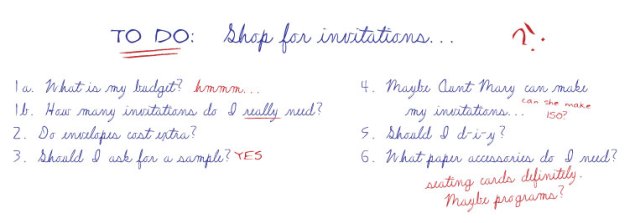
  1. Know your budget and your quantity. Is your budget for invitations and paper goods $200 or $2000?  And more importantly: how many invitation ensembles need to fit into that budget?  The biggest mistake I see couples make when they shop for wedding invitations is not knowing their quantity.  Buying the appropriate quantity of invitations is so important to making the most of your stationery budget.  Many couples accidentally count guests when they should be counting addresses.  Remember that you’ll be sending only one invitation to families and couples.  A good rule of thumb if you’re in the beginning-stages of invitation shopping and you haven’t yet verified your address list is to get quotes for 60% of your guest count.  For example, if you’re inviting 100 guests, you’ll probably only need to send invitations to about 60 addresses.  So if your invitation budget is $1000 in this scenario, your per-ensemble budget just went from $10 per ensemble if you buy based on guest count to $16.50 per ensemble if you buy based on address count.  That’s a really significant increase, and you now have room in your budget for lots of invitation “bells and whistles.”  Be sure to verify your actual address count before purchasing your invitations.
  2. Calculate all costs before deciding to buy. Many online sites that sell pre-designed invitations break down pricing by invitations, envelopes, enclosure cards, and address printing costs.  The reason for this is that some brides need three enclosure cards sent with each invitation and some only need one.  Some don’t want to pay extra for return address printing, and some choose to.  That makes sense.  The problem is, some sites advertise “$349 for 100 invitations” (and pocket invitations, too!) and that’s where the problem starts.  Great deal, right?  Well, yes, but not as good as it sounds.  It is $349 for 100 pocket invitations, but by the time you buy envelopes ($25), return address printing ($20), response enclosures ($55) and 2 additional enclosures ($49 each), your total is now $547 – $200 more than what you thought you were getting into.  So take that into consideration while comparing prices of invitations from site to site, stationer to stationer.
  3. Always get a sample. A few years ago, a local bride hired me to create her wedding programs, table numbers, and favor tags.  She told me she wanted them to coordinate with her wedding invitation, which were created by another stationer so I asked her to bring me an invitation to reference.  She did.  I brought the invitation back to my studio, and as I removed it from the envelope, it literally fell apart – no assistance from me.  It was a three-layer flat invitation and the layers were held together with photo splits – one tiny square in each corner – and I guess they didn’t feel like holding on anymore!  Honestly, the design was beautiful, but the quality was horrible.  When you receive a sample from your stationer before buying, you know what to expect: you know the quality, the feel, the weight, the smell, the everything.  This protects you from buying invitations that look gorgeous online but fall apart in your hand, smell like Raid (that’s another story!), or are poorly cut or printed.
  4. Work with a professional whenever possible. In the above story, some of you might be wondering, “Why didn’t the bride purchase her programs, table numbers, and favor tags from the original stationer in the first place?”  Here’s why:  the original “stationer” was her friend who is in college for graphic design.  As I said, the design was beautiful, but it ended up taking her friend days longer than expected to assemble the invitations (which might account for them falling apart) and in the end, she just ran out of time to make the accessories.  So what started as an inexpensive alternative to invitations and paper goods ended up being a last-minute scramble and an unbudgeted expense for the bride.  When asking or allowing friends or family to create part of your wedding day, come into it with a clear understanding that the end result might not be what you expect, and that your friend or family member is not contractually obligated to complete your “order” as requested or in a timely manner.  If you’re okay with that, go for it.  If you’re not okay with everything being just the way you envisioned, work with a professional.
  5. If you DIY, know why you DIY. I know that DIY brides all have different reasons for going the DIY route.  For some, it’s cost.  For others it’s the need to have control of design and creation.  For more, it’s the desire to have a highly-personalized wedding.  I understand those reasons and relate to them myself.  I was actually very much a DIY bride.  The thing is, you (one person) don’t have unlimited time, money, and resources to plan this wedding.  If cost is your reason for DIY, then do a cost analysis of the materials, supplies, and equipment you’ll need to buy to manufacture your own paper goods.  I often hear brides laugh that they went so overboard on materials, or had to buy this new whizbang gadget or the other to get the job done, that they didn’t save any money in the long run (and some go over budget, too).  A cost analysis will help you determine if you should DIY or opt to buy inexpensive invitations through a catalog or online.  If control is your reason, then to you I suggest prioritizing.  As I said, you don’t have unlimited time before your wedding arrives.  So determine what things are most important to you to make yourself, and then make those things first.  Don’t be too disappointed if you have to buy, borrow, or rent some of your lower-priority items in the end.  And if your reason for DIY is personalization, then consider hiring someone to do some of that personalization for you.  You can bring your ideas, your personality, and your style to a professional (stationer, baker, decorator) and have them make it your way.  (That’s kind of what we do!)  And that way, you save time in assembly, you save money in equipment and supplies, and you save stress in trying to get it all done on time.
  6. Know what wedding stationery items you need. Have a plan not only for invitations and enclosures, but for all paper goods.  Do you want custom wedding programs?  Do you have a need for table numbers, seating cards, and menus?  Would custom favor tags make your reception perfect?  And don’t forget you’re going to need to thank everyone for all those gifts.  Knowing what items you need can save time and money, especially in the custom world, since your custom stationer can order all materials at once and save on shipping costs and procurement time.

There you have it!  Six things to think about before buying your wedding invitations.  I hope you found this helpful!

{Invitation Inspiration} Silk & Fabric Invitation Boxes

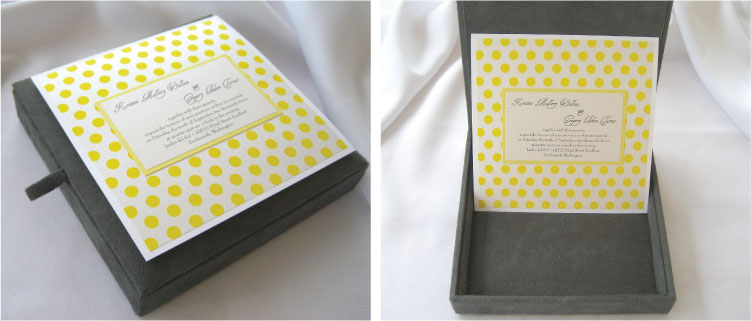
Yellow and gray polka-dotted wedding invitation in invitation boxYellow and gray polka-dotted wedding invitation in invitation boxYellow and gray polka-dotted wedding invitation in invitation box

The two most common things I hear from my clients is that they want their invitation to make a big first impression and they want an invitation that guests will want to save as a keepsake.  There are many ways to achieve those goals, and here’s one way of sending invitations that guarantees to impress and has only the tiniest chance of ever being disposed of: the invitation box.

There are many types of invitation boxes, but today’s post is about those made with silk and fabric.  Sturdy boxes enveloped in 100% silk are the ultimate way to send luxe invitations, not only because of the natural luxury of pure silk, but also because gorgeous dimensional elements can easily be added to your wedding ensemble, such as brooches, feathers, heavy trims, lace overlays, and large crystals.  Silk invitation boxes are perfect for black tie weddings and the most luxurious of events.

But boxes aren’t just for the most poshly planned events.  Invitation boxes are made using a variety of other fabrics, like the microsuede shown in the photos above, glitter fabrics, satins, and even cottons.  So whether you’re planning an intimate garden wedding, a blingy Sweet 16, or a young man’s Bar Mitzvah, there are fabric box options for you.

And if your budget doesn’t quite permit the expense of fabric boxes, there are alternative – but just as impressive – options, such as folios, silk-covered invitation boards, and fabric invitation pouches.  I’ll be posting more about these other options over the next several weeks, so keep checking back!

The gray and yellow wedding invitation in the photos above is layered with textured whites and pearlized whites, and printed with polka dots in bright sunshine yellow.  It is placed in a square microsuede invitation box in stone gray.  This wedding invitation is mailed using a white outer mailer and custom mailing labels to coordinate with the invitation design that can be addressed by your hand or a professional calligrapher’s.

Invitations: Dogwood Blossom Stationery & Invitation Studio, LLC

{Real Event} Nathan’s Vintage Travel Bar Mitzvah

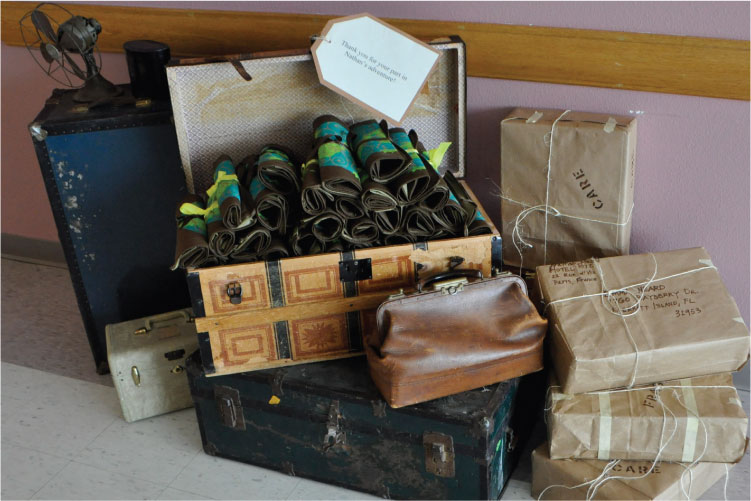
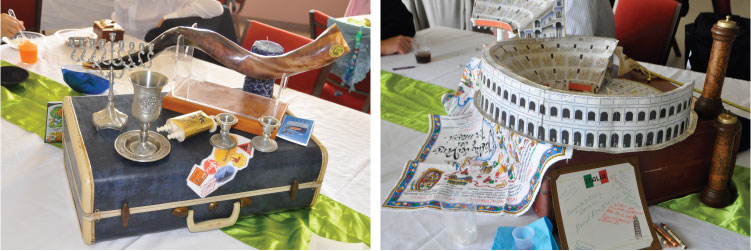
Nathan loves the idea of travel and seeing new things, so his “Travel in the 1940s” theme for his Bar Mitzvah was a good fit.  At his reception, each of the 10 tables contained a unique-themed centerpiece from Israel, France, Egypt, the US, Italy, Brazil, Canada, Mexico, Greece, or England.  He and his family spent months before his big day collecting props and souvenirs from each of those countries to decorate the reception hall.  Nathan and his dad also custom-built table centerpieces of a sphinx, an Egyptian pyramid, and the Eiffel Tower.   While friends and family contributed a lot of the props from their own collections, Nathan’s mom was surprised to find that they already had a lot of vintage souvenirs and travel-related items at home.  They scoured local thrift stores for the pieces they couldn’t find at home or at a friend’s home.  Every decor detail was covered!

As part of his Bar Mitzvah, Nathan requested that guests bring canned goods and non-perishable food items for donation to a local food pantry.  To tie in with both his vintage luggage and the donation of grocery items, Nathan offered reusable grocery bags that were screenprinted with a globe to each guest as party favors.

When I met with Nathan and his family to discuss his 40s-travel-themed invitations for his upcoming Bar Mitzvah, I was impressed by his knowledge of other countries and their cultures.  Nathan wanted his invitation to look like a vintage suitcase loaded with travel stickers, so we made a folding invitation using brown cardstock that opened like a suitcase.  The “suitcase” contained stickers from his 10 chosen countries, and a luggage tag announcing, “Traveling to:  Nathan’s Bar Mitzvah.”  Because the family had planned an entire weekend of events, we chose to use the space inside the suitcase to mimic a train ticket and itinerary, complete with travel stamps.  For the reception, we created special guest book pages to be placed at each table and then combined into a book after the event.  Each guest book page contained a different country sticker from the “suitcase” as well as other cultural references from that country.  Guests were given colored pencils to leave Nathan their message, drawings, and wishes of good luck.

In addition to his pride in becoming a man and the years of studying and work that led to his becoming a Bar Mitzvah, Nathan’s favorite things surrounding his day included all the planning details.  He had a really good time working with his dad to build centerpieces, and working with the baker to design his cake and choose his flavors.

Thank you, Nathan, for letting Dogwood Blossom Stationery be part of your Bar Mitzvah!

Traincase display with party favorsTrain ticket and vintage suitcase Bar Mitzvah invitationNathan, an old typewriter, and a suitcase cakeCountry-themed centerpieces at every table

Photography:  Friends of the family

Centerpieces:  Nathan & Family

Invitations & Guestbook Pages:  Dogwood Blossom Stationery & Invitation Studio

Cake:  Heavenly Bake Shoppe, Cocoa Village, FL

{Etiquette} Addressing Your Wedding Invitations

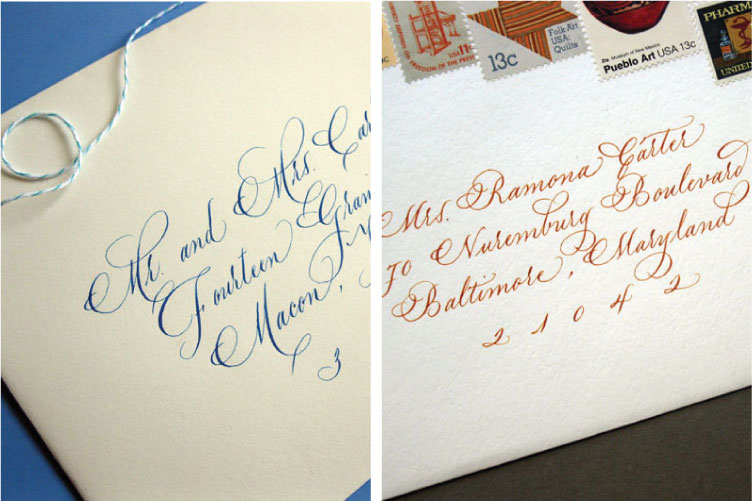
Grace Edmands CalligraphyCalligraphy by Grace Edmands Calligraphy (thanks Grace!)

Today I wanted to share some outer envelope addressing etiquette with you.  I’ve been collecting this information for years from various sources as different scenarios have come up for my clients.  Family situations have grown more complex in recent years, so I’ve tried to include the basics as well as the more complicated scenarios.  Though I’m not a bonafide etiquette expert (as proven by my personal story at the end of this post), if you need help with addressing an invitation to a family whose situation is not covered in this post, let me know, and I’ll see if I can track down the answer for you!

FIRST, a few basic tips:

  • Always use proper titles for doctors, PhDs, military officers, etc.
  • Address the invitation to all who are invited, by name
  • Medical doctors should be addressed using “Doctor” and PhDs should be addressed using “Dr.”
  • Address both active duty and retired military officers with their proper titles
  • Always spell out names of cities and states, and words like “Street”, “Avenue”, “Suite”, “Apartment”, etc., with the exception of “Washington, D.C.”


MARRIED COUPLES
Same last name: Mr. and Mrs. John Smith

Wife uses her maiden name, use “Mrs.” and place her name on the line above his:
Mrs. Jane Jones
Mr. John Smith

Same last name, but wife has a proper title and the husband does not, place her name above his:
Doctor Jane Smith
Mr. John Smith

Husband has a proper title and wife does not: General and Mrs. John Smith

Both the husband and wife have the same proper titles: Drs. John and Jane Smith

Husband and wife have different proper titles, put wife first:
General Jane Smith
The Honorable John Smith


INVITING CHILDREN UNDER 18
Place children’s names on a separate line below their parents.  If children have the same last name as their parents, only write their first names.  If children have different last names than their parents, include their last names.  Invited children over 18 should receive their own invitations, whether or not they reside with their parents.  For them, use the rules for “single guests.”

Invited children under 18 with the same last name as their parents:
Mr. and Mrs. John Smith
Mary, Elizabeth, and Joseph

Invited children under 18 with different last names than their parents, use separate lines:
Mr. and Mrs. John Smith
Mary and Elizabeth Jones
Joseph Smith


SINGLE GUESTS & UNMARRIED COUPLES
Single guests use Ms., Miss, or Mr., or their proper title: Ms. Elizabeth Rogers   -or-  Doctor Henry Jones

Unmarried and/or same-gender couples living at same address should be addressed alphabetically by last name:
Ms. Mary Jones
Ms. Elizabeth Rogers


SO NOW FOR A TOUGH ONE
How do you address an invitation to a military husband with a medical doctor wife with five kids under 18 (who are invited) who all have different last names?
Doctor Jane Smith
General John Jones
Mary, Elizabeth, and Ryan Smith
Joseph and Henry Jones


AND NOW MY EMBARRASSING STORY
When I got married, I addressed my own invitations.  (I didn’t have the pleasure of hiring a great calligrapher like Grace Edmands.)  I researched proper etiquette for addressing, of course, but I still made an embarrassing error:  I addressed the invitation to my husband’s boss as “Mr.” when it should have been “Dr.”  Now that I think about it, his wife might be “Dr.” too!  I feel badly that I didn’t show the proper respect for his title.  I simply forgot that he had a proper title, because I usually just call him “Bob.”  But you know what?  I don’t think he ever held it against me.  He’s never mentioned my error.  And my husband still has a job, lol!

So the lesson is twofold:  First, do your best to address your invitations properly.  Second, if you make a mistake, don’t beat yourself up.  Reasonable people will forgive you for your oversight.  In the end, we’re all just human.

{Retro-Mod} Finding Inspiration in Everyday Objects

Red Retro-Mod Wedding Invitation
Red and white retro-mod dot-and-line pattern
Punch cup with retro-mod design

Today I wanted to write about finding inspiration in everyday objects.  When I speak with new clients, I always ask them to send me “inspiration” for their invitation.  I tell them to show me photos, designs, motifs, and styles that appeal to them.  This inspiration is so important in helping me get to know my clients and understand their taste preferences!

Anyone who knows me well knows that I collect glassware.  I like it all, from expensive cut crystal to cheaply etched brandy snifters.  As long as it’s something you don’t see everyday (or anymore), I crave it.  Thrift stores and flea markets are great places to find these poor little cast-off glasses that I find so intriguing.  Recently, at a flea market, I found a set of these retro-mod punch cups.  They have tiny little round handles and a white painted-on pattern of lines and dots.  I fell in love with them, instantly.

Earlier this week I was admiring my mishmash collection of glassware and my little punch cups stood out.  I decided to use them as an example of finding inspiration in everyday objects, and I created a simple invitation based on their retro-mod pattern.  It would be so easy to create an entire wedding suite using this design in white and bold red.  I can easily see a table with lines of seating cards, each one coordinating perfectly with the invitation; white favor boxes containing truffles, wrapped in paper bands printed with the same red mod pattern; matching menus at each place setting would add instant (and easy) color to tables, and red textured thank you cards adorned with dots and lines would round-out this wedding suite perfectly…  All this from a punch cup I picked up at a flea market!

I wonder what you have – in your life, your collections, your living space, your imagination – that would make great inspiration for an invitation design.  I hope you’ll share your thoughts with me!

Real Wedding: Rita & Franck’s Sapphire Blue and Lemon Yellow Wedding

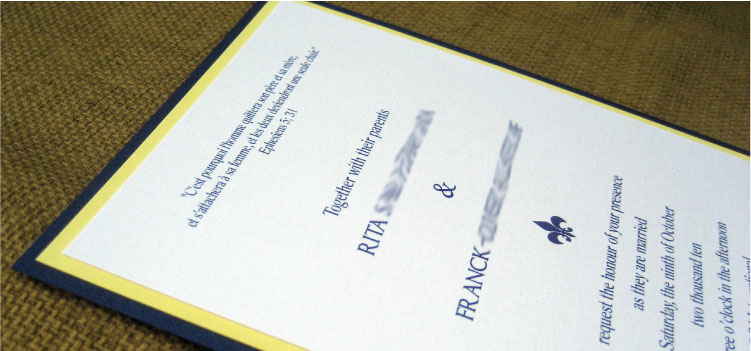
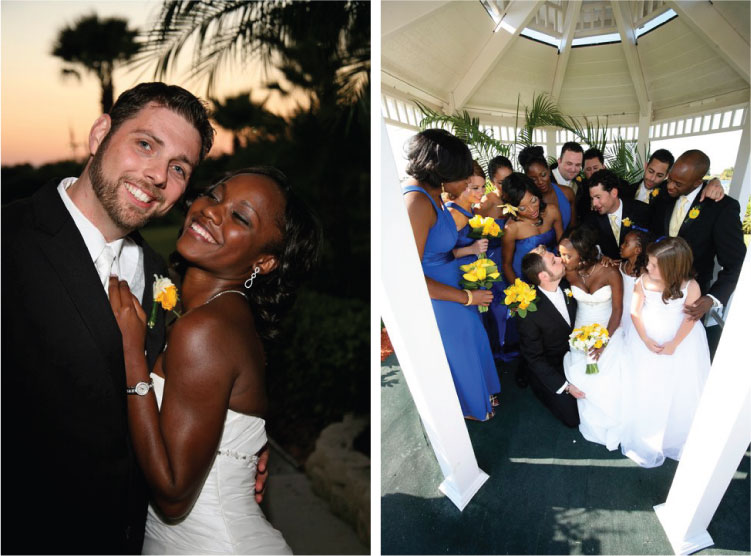
Rita and Franck’s wedding day in October at LPGA International was full of special touches and attention to detail.  As the couple are French, as were some of the guests, they chose lots of classic French detail, such as a fleur de lis motif, a croquembouche wedding cake, and even a Bible verse printed in French on the invitations being sent to French-speaking guests.

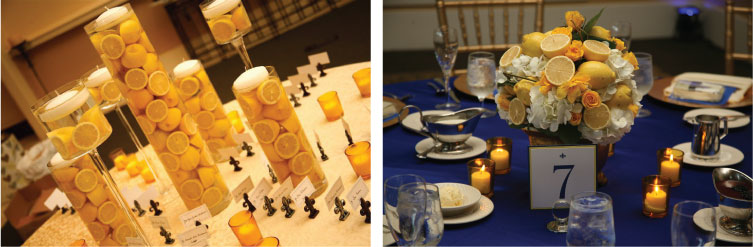
Rita and Franck chose a color palette of lemon yellow, used for flowers and decor, against a sapphire blue backdrop.  I love Rita’s decision to incorporate real lemons and lemon halves into the centerpieces and decor.  I’m betting their reception smelled wonderful!  They worked in the fleur de lis motif where possible, on printed paper goods and on the seating card holders.

A croquembouche was served as the wedding cake, as is traditional for French weddings.  Gorgeous all by itself – created by mounding profiteroles into a cone and dripping it with sweets – it was made even more spectacular with flowers and curled lemon-zest decoration worked into the tower.  Rita also gave Franck a sweet surprise with a really lovely groom’s cake decorated with the Arsenal Football Club logo in fondant!

Dogwood Blossom Stationery created a fairly traditional, layered wedding invitation for Rita and Franck.  Rita chose pearlized dark sapphire blue paper paired with matte lemon  yellow.  We accented the invitation with a small fleur de lis  in the perfect middle.  Square table numbers were created using the same papers and motif for the couple’s reception.  And because Rita and Franck wanted to give something special and personalized for their wedding favors, we created custom recipe cards using the couple’s favorite family recipes.

What a beautiful wedding!  Thank you, Rita and Franck, for letting me be part of you day!

PS – You can see a few more photos of Rita & Franck’s day on the With This Ring blog here.

Sapphire & Lemon Yellow Fleur de Lis Wedding Invitation

Rita & Franck

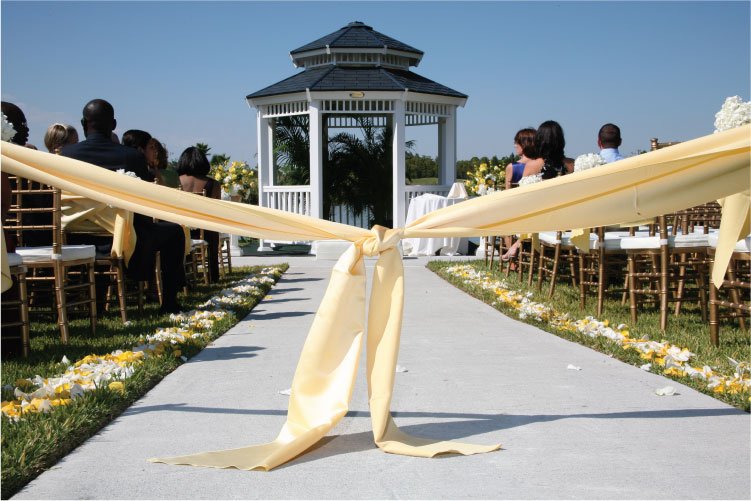
Buttercream Yellow Aisle Ribbon

Sapphire & Lemon, Fleur de Lis, Table Number

Blue Fleur de Lis Recipe Card Favors

Croquembouche Wedding Cake & Arsenal Football Grooms Cake

Photography:  Jen Adams Photography

Venue:  LPGA International, Daytona Beach, Florida

Planner:  With This Ring, Inc.

Wedding Cake:  The Pastry Studio

Wedding Invitations, Table Numbers, & Recipe Favor Cards:  Dogwood Blossom Stationery & Invitation Studio

Are you planning a uniquely detailed wedding like Rita and Franck’s?  Need help finding the perfect invitation to go with  your color scheme or theme?  Click here.

Thanks for commenting and sharing this post!

Taking on a new challenge in 2011

I’m taking the Post-A-Week challenge here on WordPress.  Considering I just started this blog about a week ago, I hope this challenge will help give me a good start to a happy and healthy blog…   And maybe I’ll make a few new friends along the way.

So, if you’re already reading my blog, THANK YOU, and please keep coming back to encourage me with comments and likes.  Please share this blog and posts that you find interesting with your friends, too, because I’m sure they’re also good at encouraging, commenting, and liking.

Wishing you a happy new year!  2011 has great things in store for all of us.